
Search Cherokee County Court Records
Cherokee County Court records now use the statewide North Carolina eCourts Portal for many public case searches. The portal includes Smart Search for case information, Search Hearings for court dates, Make Payments for eligible citations and fees, and NC Judgment Search for judgment index records. It is a public Judicial Branch system, but it is not a certified background-check service and it does not replace the Clerk of Superior Court for official copies.
The strongest search method is a channel stack. Start with the portal when the case number, party name, citation number, or hearing detail is known. Narrow the location to Cherokee County so a statewide name search does not pull in the wrong county. If the record is missing, sealed, older, or needed for court or employment use, the next stop is the Clerk of Superior Court at the Murphy courthouse.
- Open the eCourts Portal and choose Smart Search for public case information.
- Enter a case number or a party name in Last, First Middle format.
- Use wildcard rules only when needed. A case-number wildcard needs at least four characters, and a name wildcard needs at least three last-name characters plus one first-name character followed by an asterisk.
- Open Advanced Filtering Options and set the location to Cherokee County.
- Review public case details, docket entries, hearings, and payment links that appear.
- Use the Clerk of Superior Court for certified copies, paper files, or a certified single-county criminal record search.
The official Judicial Branch location page for Cherokee County appears in the manifest source list as the county court landing page.
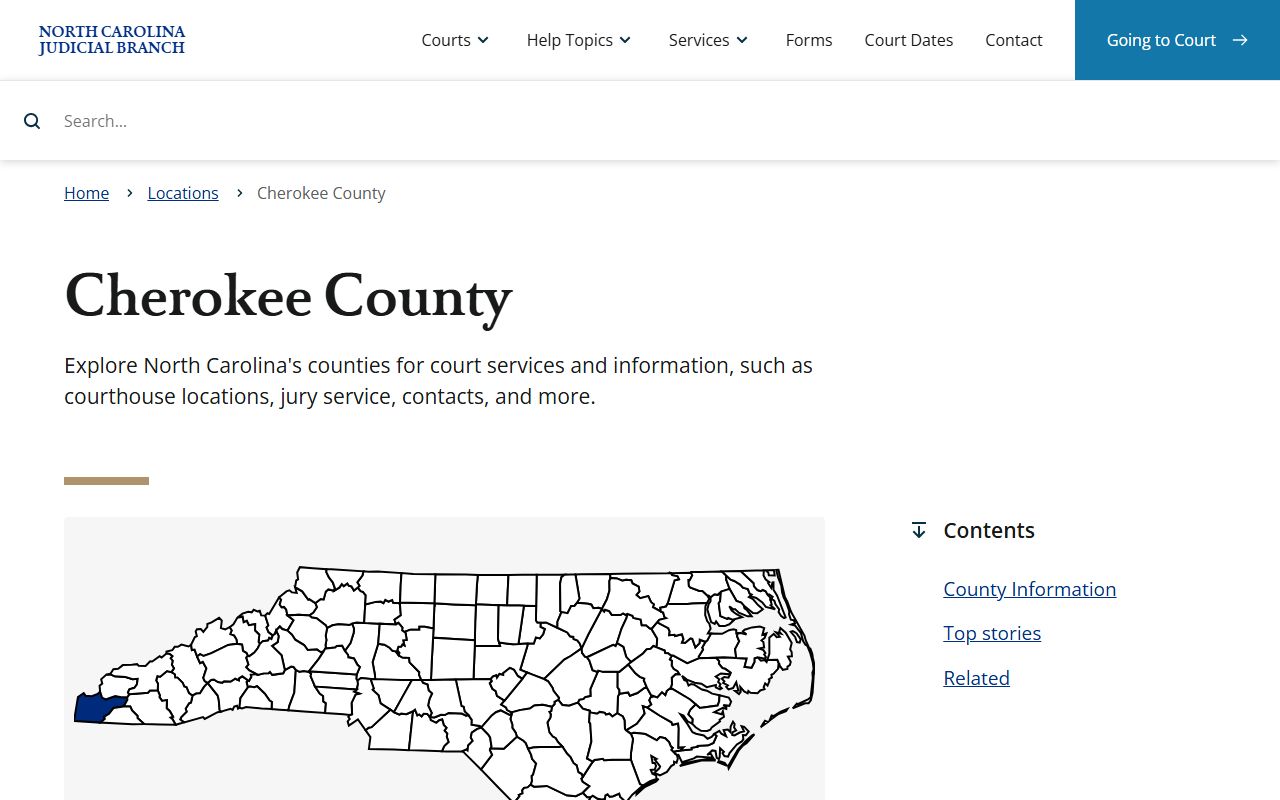
That county landing page is the starting point for court dates, courthouse pages, payment information, jury service, and local rules tied to Cherokee County Court records.
Cherokee County Court Search Fields
The Smart Search screen accepts both broad and narrow searches. A case number is best when it is available. A party-name search can work, but the portal can return similar names from across North Carolina if the Cherokee County location filter is not used. Advanced filters such as date of birth, case type, case status, and filing dates help separate one person or file from another.
| Field Label | Type | Required | Format Notes |
|---|---|---|---|
| Record Number or Name | Text | Yes | Use exact case number or Last, First Middle Suffix. |
| Last Name / First Name | Text | Conditional | Required for party searches when no case number is used. |
| Filter by Location | Dropdown | No | Select Cherokee County to reduce statewide matches. |
| Filter by Search Type | Dropdown | No | Party Name, Nickname, Business Name, or Sounds Like. |
| Date of Birth From / To | Date | No | Advanced filter for party searches. |
| Case Type / Case Status | Dropdown | No | Useful for criminal, civil, estate, or traffic filtering. |
| File Date Start / End | Date | No | Narrows cases to a known filing period. |
The manifest also captured the statewide portal home source for Cherokee County Court records access.
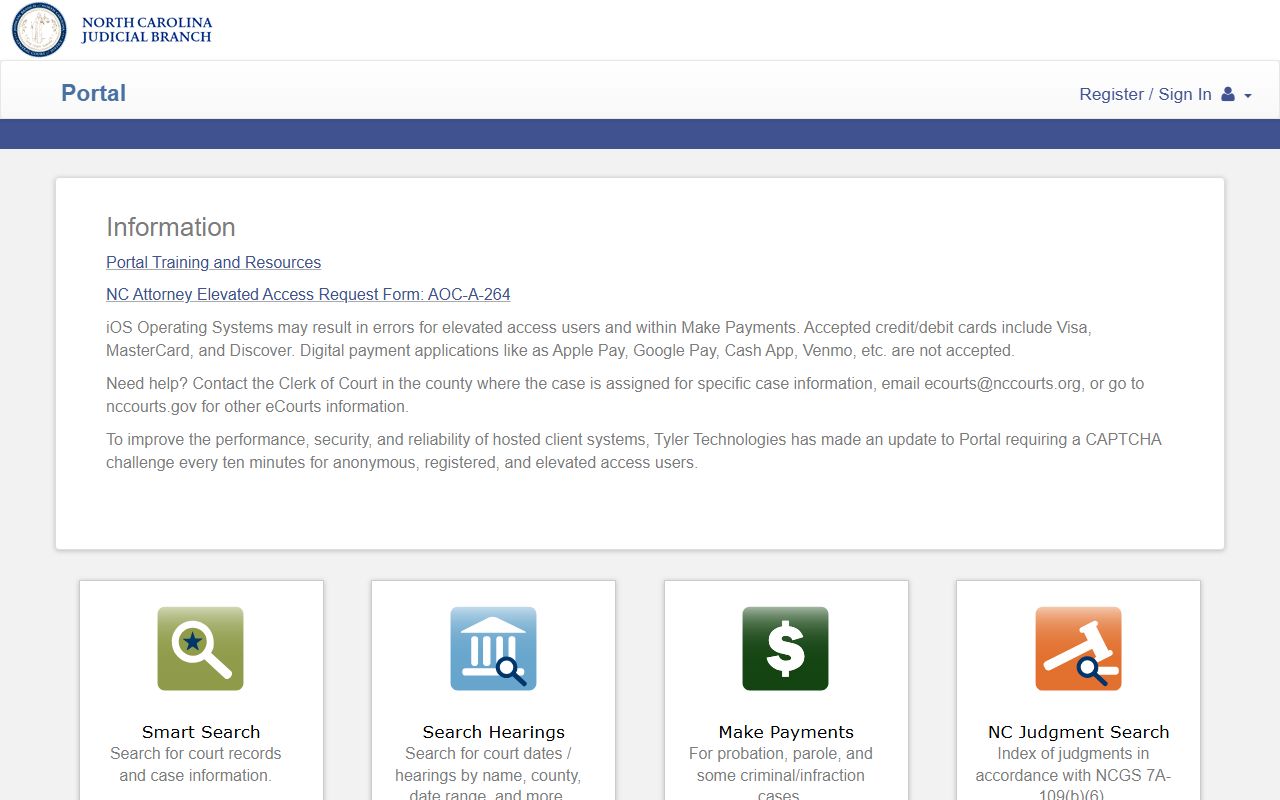
The portal is useful for public case data, hearings, payments, and judgments, while certified and official records remain a clerk function.
Cherokee County Court System
Cherokee County is part of North Carolina's unified state court system. The county is in Prosecutorial District 43, Superior Court District 43A, and District Court District 43. Superior Court and District Court both operate through the North Carolina Judicial Branch, not through a separate county-run court system. The Clerk of Superior Court is the main court-records office.
Case flow: Magistrate process or filing › District Court or Superior Court › North Carolina Court of Appeals › North Carolina Supreme Court.
| Court or Office | Role in Cherokee County | Common Record Types |
|---|---|---|
| Superior Court | Higher trial court | Felonies, civil cases over $25,000, appeals from District Court misdemeanors and infractions |
| District Court | High-volume local trial court | Misdemeanors, traffic infractions, divorce, custody, support, juvenile matters, civil cases under $25,000 |
| Magistrates | Judicial officers within District Court | Warrants, bail, small claims, landlord-tenant matters, certain waivers |
| Clerk of Superior Court | Record custodian and judicial officer in estates | Court files, certified searches, divorce judgments, estate files, special proceedings |
The county courthouse source in the image manifest points to the official courthouse page.
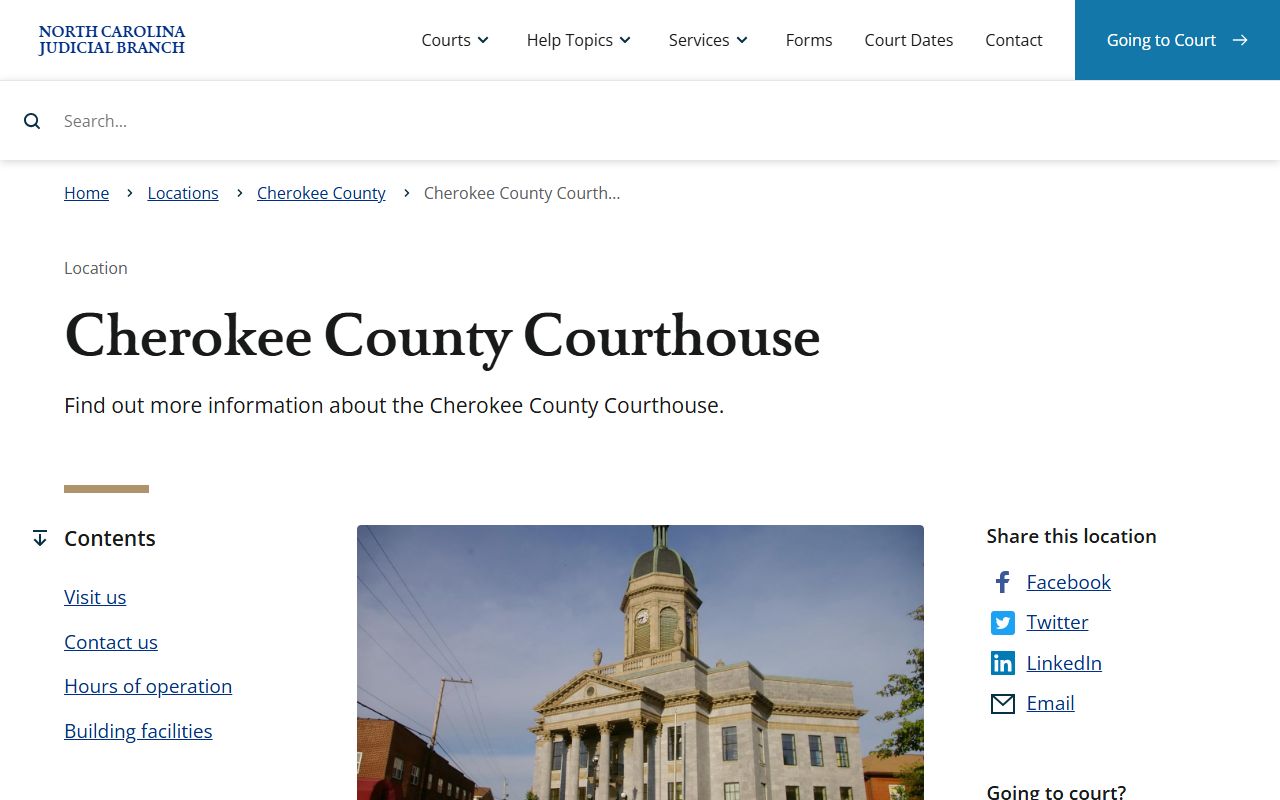
That courthouse page ties the physical Murphy location to Superior Court, District Court, the clerk counter, payment questions, and in-person record access.
Cherokee County Court Record Types
Court records in Cherokee County are not one file type. Criminal files, civil lawsuits, family-law cases, traffic citations, estate files, judgments, small claims, and special proceedings can all follow different search paths. The same person may also have a jail custody record, a court charge, a DMV driver record, and a state prison record in separate systems.
- Criminal court records: charges, hearings, pleas, motions, judgments, sentences, costs, probation terms, and appeal entries when public.
- Civil court records: complaints, answers, orders, judgments, liens, foreclosures, partitions, collections, and other civil filings.
- Family and divorce records: divorce, custody, child support, and equitable distribution matters, with divorce judgments requested from the clerk.
- Estate records: wills after probate, applications for letters, inventories, accountings, orders, and special proceeding material kept through the clerk.
- Traffic court records: citations, waivers, court dates, fines, costs, judgments, and DMV reporting outcomes.
- Judgment records: judgment index information available through the NC Judgment Search and clerk-maintained records under state law.
What Cherokee County Court Records Show
A public case view may show enough to identify the file and track its status, but it may not show every document. Online public access can differ from clerk-certified copies. Some records are paper-based or county-based even when a search result appears in eCourts. For criminal and traffic matters, the court record also differs from jail roster data and NCDMV driver history.
| Field | What It Shows |
|---|---|
| Case Number | The court's identifier for the file or record. |
| County or Location | Whether the matter is assigned to Cherokee County or another North Carolina county. |
| Case Type and Status | The broad category and current posture, such as pending, disposed, or closed. |
| Parties and Attorneys | Names of defendants, plaintiffs, petitioners, respondents, and counsel when public. |
| Hearings and Docket Events | Scheduled dates, courtroom references, filings, orders, continuances, and case activity. |
| Judgment or Disposition | The outcome of a claim, charge, citation, or petition when the record has reached that stage. |
Cherokee County Court Access Laws
North Carolina law supports public access to many government and court records, but it also creates limits. Cherokee County Court records should be checked through official systems first: eCourts for public case information, the Clerk of Superior Court for certified or paper records, and the public-record request form for Judicial Branch administrative records that are not local case files.
Key Statutes:
N.C.G.S. 132-1 defines public records broadly as materials made or received in connection with public business.
N.C.G.S. 132-6.2 limits many copy charges to actual cost and does not force an agency to create a record that does not exist.
N.C.G.S. 7A-109 governs clerk record keeping and supports judgment indexing by clerks.
N.C.G.S. 132-1.4 treats law-enforcement investigative records differently from basic arrest and charge information.
Restricted Cherokee County Court Records
Not all court records are ordinary public files. Juvenile delinquency, abuse, neglect, dependency, adoption, mental health, sealed, and expunged records may be closed or limited by statute or order. Personal identifiers such as Social Security numbers, financial account data, protected addresses, and sensitive minor or victim information may be redacted before public inspection.
Expunction is the North Carolina process that can remove or seal certain eligible criminal charges or convictions from public view. Eligibility depends on the statute, the case outcome, waiting periods, prior history, the seriousness of the offense, and whether the matter is juvenile or adult. Official AOC forms and clerk filing procedures control the process.
The manifest includes an official local administrative schedules source for Cherokee County Court records and calendars.
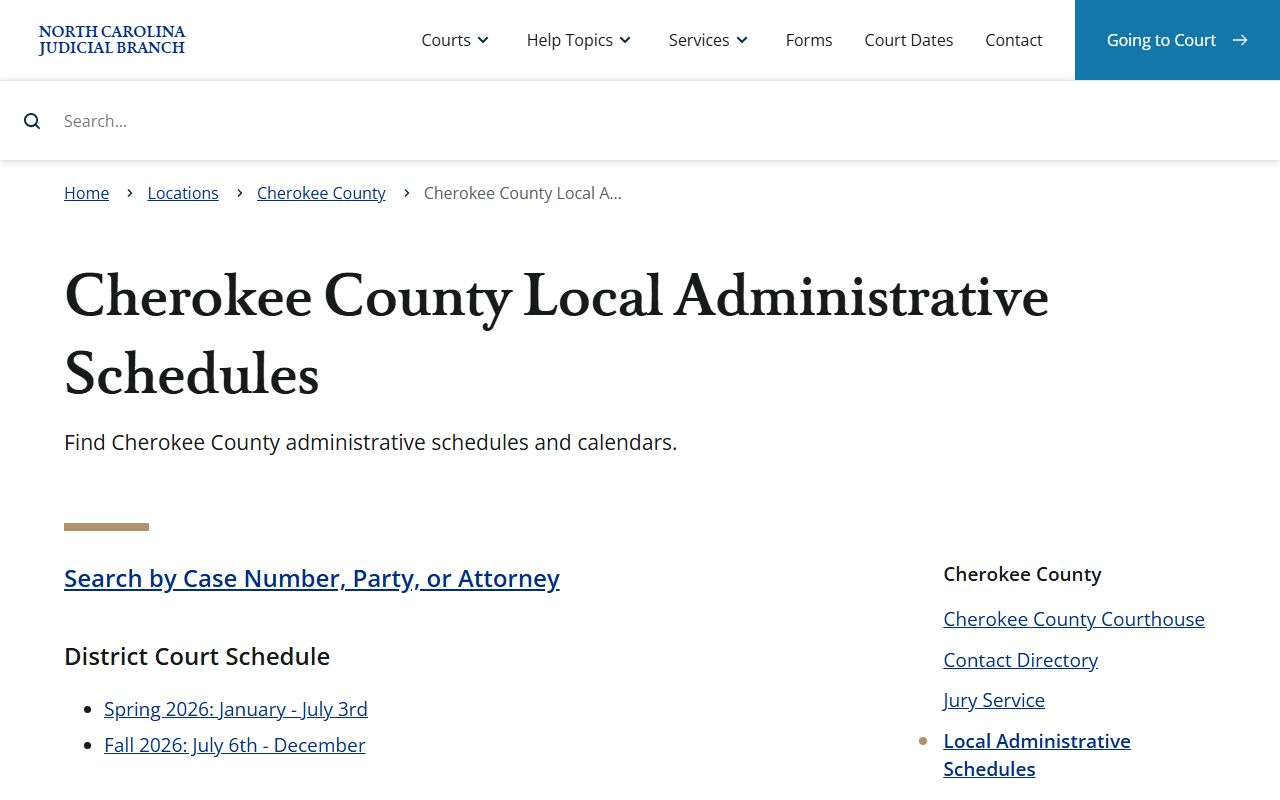
Administrative schedules and local rules can explain why some Cherokee County cases move through mediation, arbitration, calendar calls, or special local docket settings.
Cherokee County Court Clerk
The Cherokee County Clerk of Superior Court is the central court-records office. The clerk handles case files, certified criminal searches, divorce judgments, civil and criminal file access, estate administration, special proceedings, and public terminals. The research did not locate a stable official clerk biography, so public copy should refer to the office rather than a named clerk.
Cherokee County Courthouse
75 Peachtree St
Murphy, NC 28906
(828) 835-7740
Monday-Friday, 8:00 a.m.-12:30 p.m. and 1:30 p.m.-5:00 p.m.
Clerk of Superior Court
75 Peachtree St
Murphy, NC 28906
(828) 835-7740
Case files, certified searches, divorce judgments, estates, and copies
Register of Deeds
75 Peachtree Street, Suite 126-A
Murphy, NC 28906
(828) 837-2613
Marriage certificates, marriage licenses, vital records, and recorded documents
The county contact-directory source in the manifest documents the official Cherokee County court contacts.
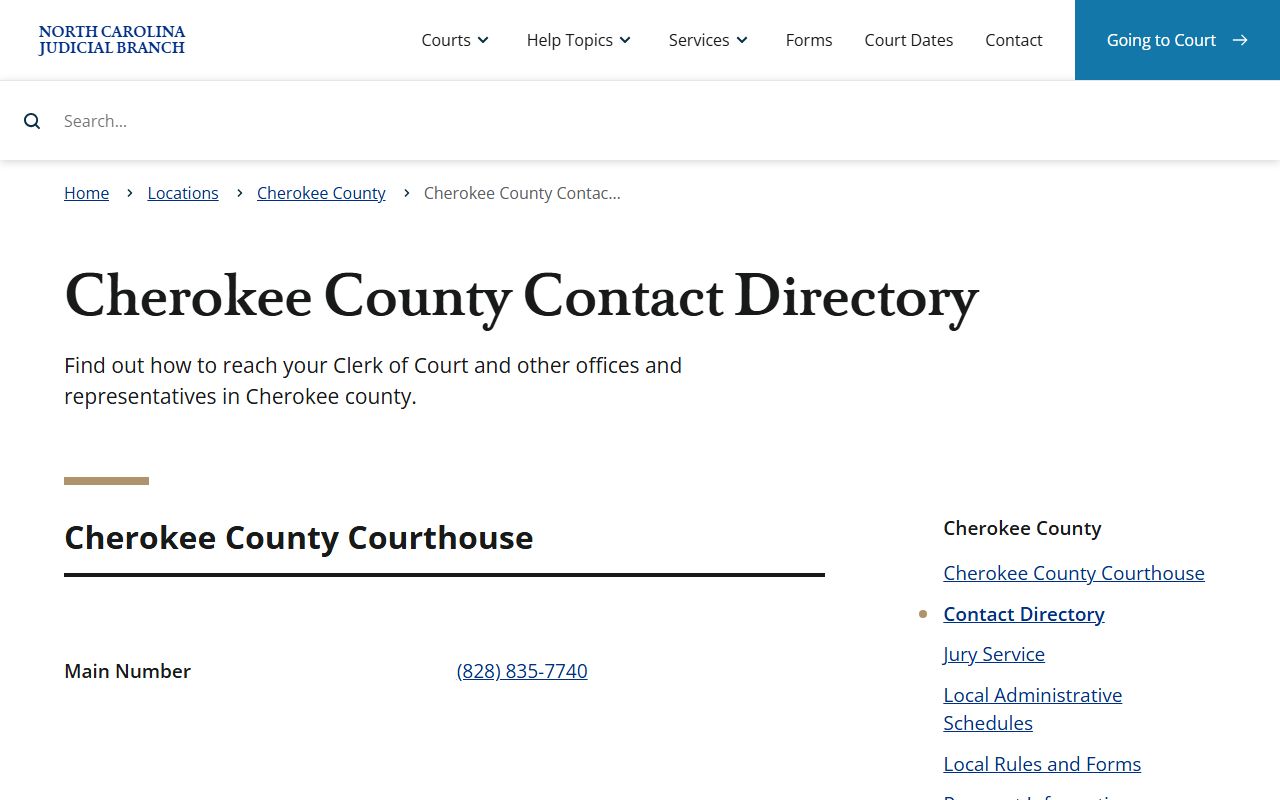
The contact directory separates clerk, judge, district attorney, magistrate, mediation, and Guardian ad Litem phone lines for court users.
Cherokee County Sheriff Records
The Cherokee County Sheriff's Office is at 577 Regal Street in Murphy. Sheriff Chris Wood is listed in county materials as appointed on February 23, 2026 to complete the term through December 7, 2026. The Sheriff's Office handles law-enforcement records, custody information, the Detention Center, most-wanted notices, and general public-safety contacts. It is separate from the court clerk, even when an arrest later creates a court case.
The Detention Center phone is 828-837-2521. The county In Custody portal lists current jail roster information, while court charges, returned warrants, and court dates should be checked through eCourts, magistrates, or the Clerk of Superior Court. No official Cherokee County NC sheriff mobile app was found in the research, so custody searches should not be described as app-based.
The image manifest includes the official Sheriff's Office source for Cherokee County records context.
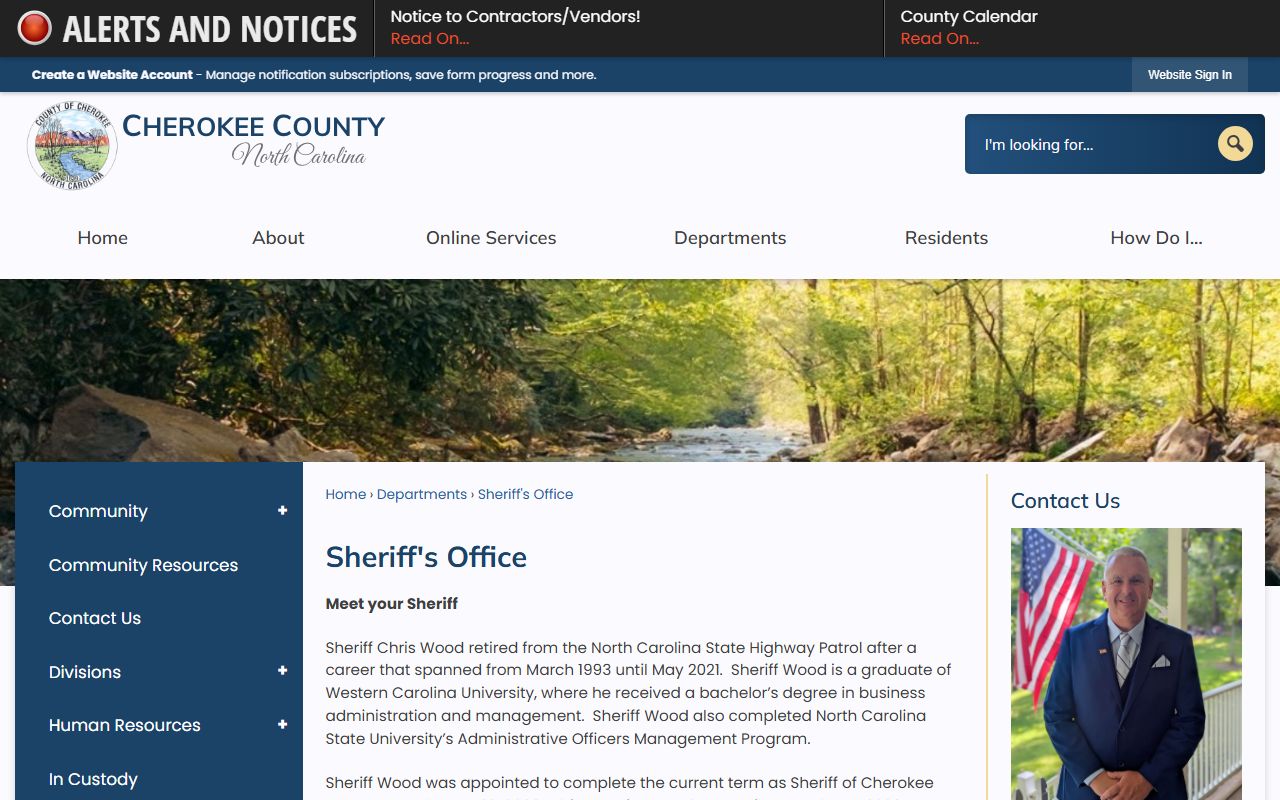
The Sheriff's Office source helps separate jail and law-enforcement contacts from courthouse records kept by the Clerk of Superior Court.
Cherokee County Court Fees
Fees depend on the record type and office. A certified single-county criminal record search through the Clerk of Superior Court is listed by the Judicial Branch at $25. The Register of Deeds charges different fees for certified marriage and vital records. Traffic fines and costs depend on the citation, eligibility for waiver, and current court-cost publications.
| Item | Amount or Rule | Office |
|---|---|---|
| Certified single-county criminal record search | $25 | Clerk of Superior Court |
| Marriage license | $60, cash only per county marriage page | Register of Deeds |
| Certified marriage certificate | $10 | Register of Deeds |
| Uncertified marriage certificate | $1 | Register of Deeds |
| Estate opening | $120 starting fee from state estates help topic | Clerk of Superior Court |
| Mail traffic payment | Money order or certified check only, no personal checks | Clerk of Superior Court |
Cherokee County Marriage Probate Records
Marriage licenses and marriage certificates are not court records in Cherokee County. They are handled by the Register of Deeds, including in-person service and the Permitium vital-records request portal. Divorce judgments are different. They are court records obtained from the Clerk of Superior Court in the county where the divorce was granted.
Estate and probate matters are handled through the Clerk of Superior Court acting in estates and special proceedings. A will has no legal effect until it is probated. Once filed after death, a will generally becomes a public record unless another rule restricts access. Estate files may include applications for letters, inventories, accountings, notices to creditors, small estate affidavits, and clerk orders.
- Executor
- A person named in a will to manage estate administration after appointment.
- Administrator
- A person appointed when there is no valid named executor available.
- Letters
- Clerk-issued authority allowing a representative to act for an estate.
- Inventory
- An estate filing that lists property and assets.
The manifest includes the Register of Deeds source used for Cherokee County marriage and vital-record distinctions.
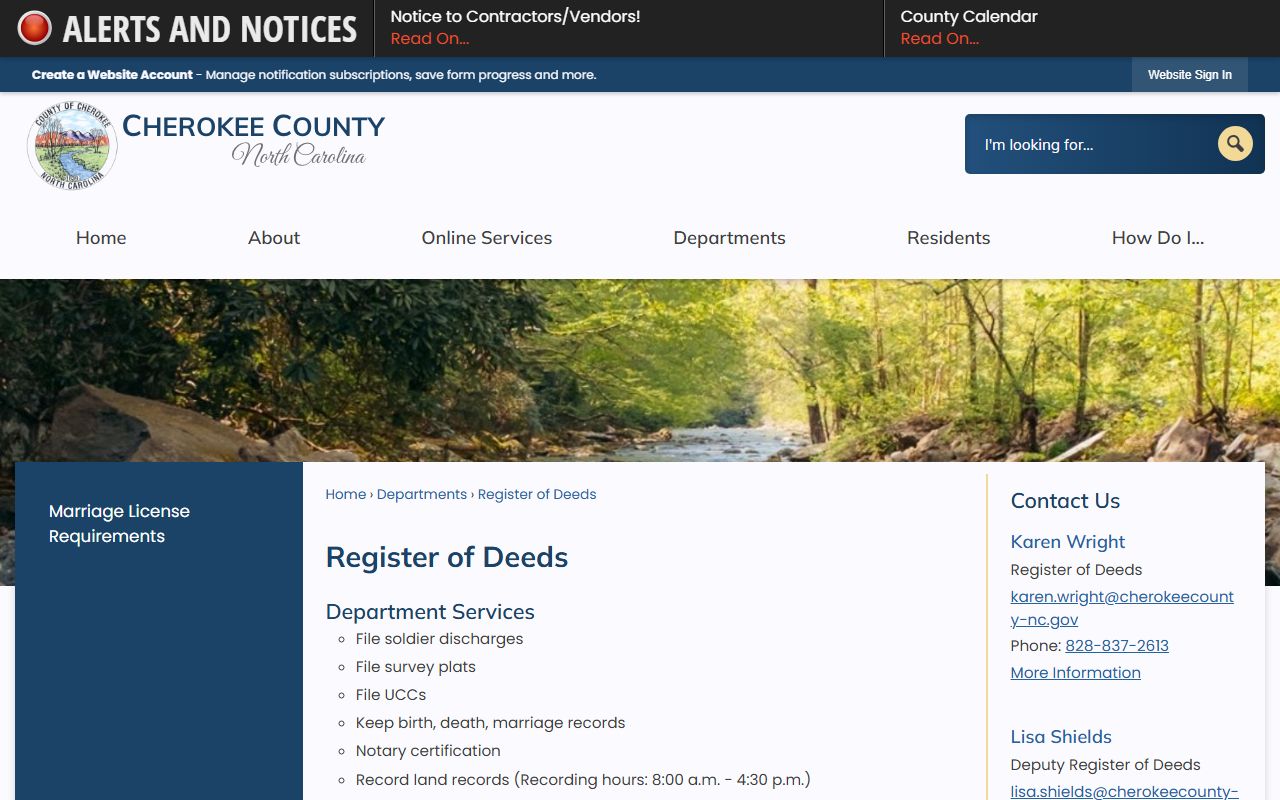
That Register of Deeds source is important because it keeps marriage records separate from divorce judgments and estate court files.
Cherokee County Court History
Cherokee County was formed in 1839 from part of Macon County, and Murphy is the county seat. Court history is tied closely to the courthouse itself. County sources state that the historic Cherokee County Courthouse was built in 1927 after a January 16, 1926 fire destroyed the prior brick courthouse. The building used Blue Marble quarried locally in the Marble community and was placed on the National Register of Historic Places in 1979.
Those courthouse transitions matter for record users because older records may have preservation issues, gaps, or location questions. The research does not confirm a specific record loss for a specific case type, so older-file questions should be checked with the Clerk of Superior Court case by case. The more recent access milestone was July 22, 2024, when Cherokee and ten other western North Carolina counties moved into eCourts digital court records.
The historic courthouse source in the manifest shows the local blue-marble courthouse context.
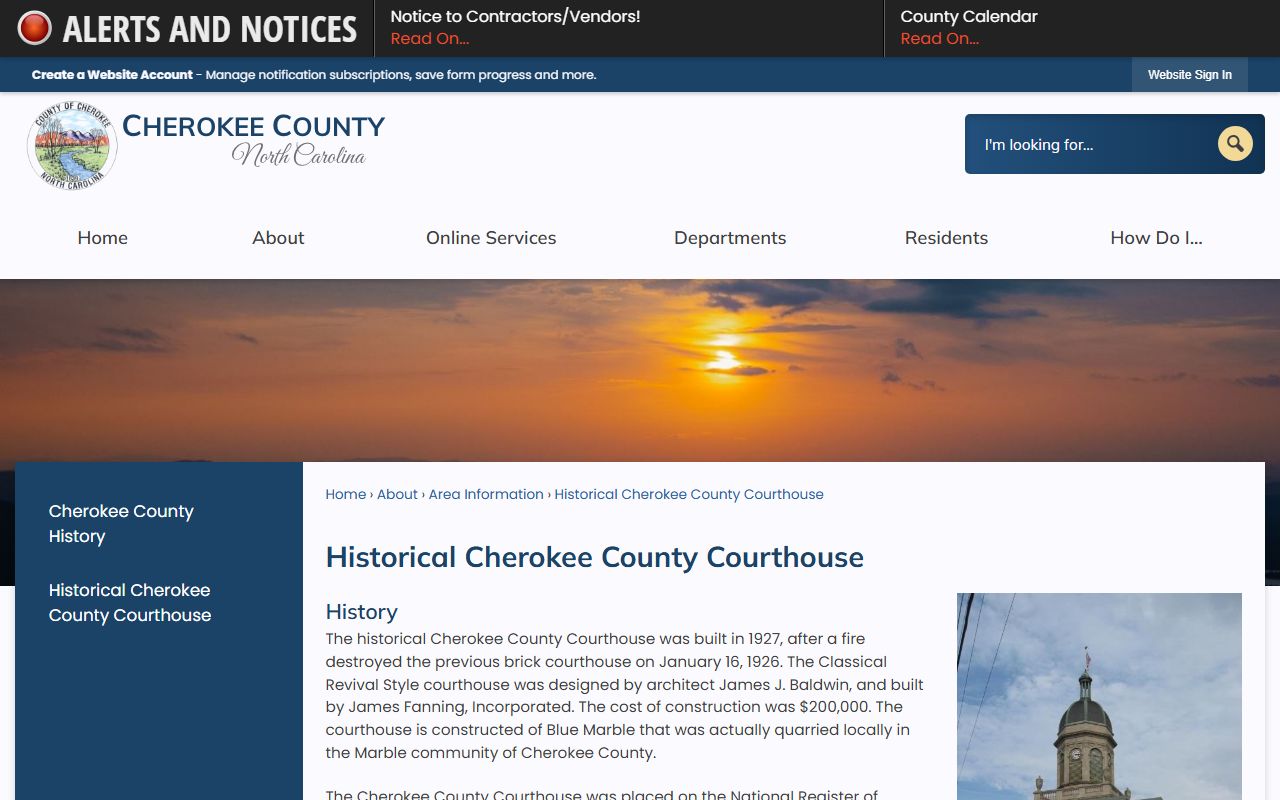
The historic courthouse detail gives Cherokee County Court records a local context that is different from many other North Carolina counties.
Cherokee County Court Location
Cherokee County is North Carolina's far western county, bordered by Tennessee and Georgia in the southern tip of the Great Smoky Mountains. Murphy is the county seat, and the courthouse sits downtown near county offices and the Register of Deeds. Visitors often need more than one office on the same trip, especially when a court matter also involves marriage records, recorded documents, jail custody, or a certified criminal search.
The county area-information source appears in the manifest for broader Cherokee County context.
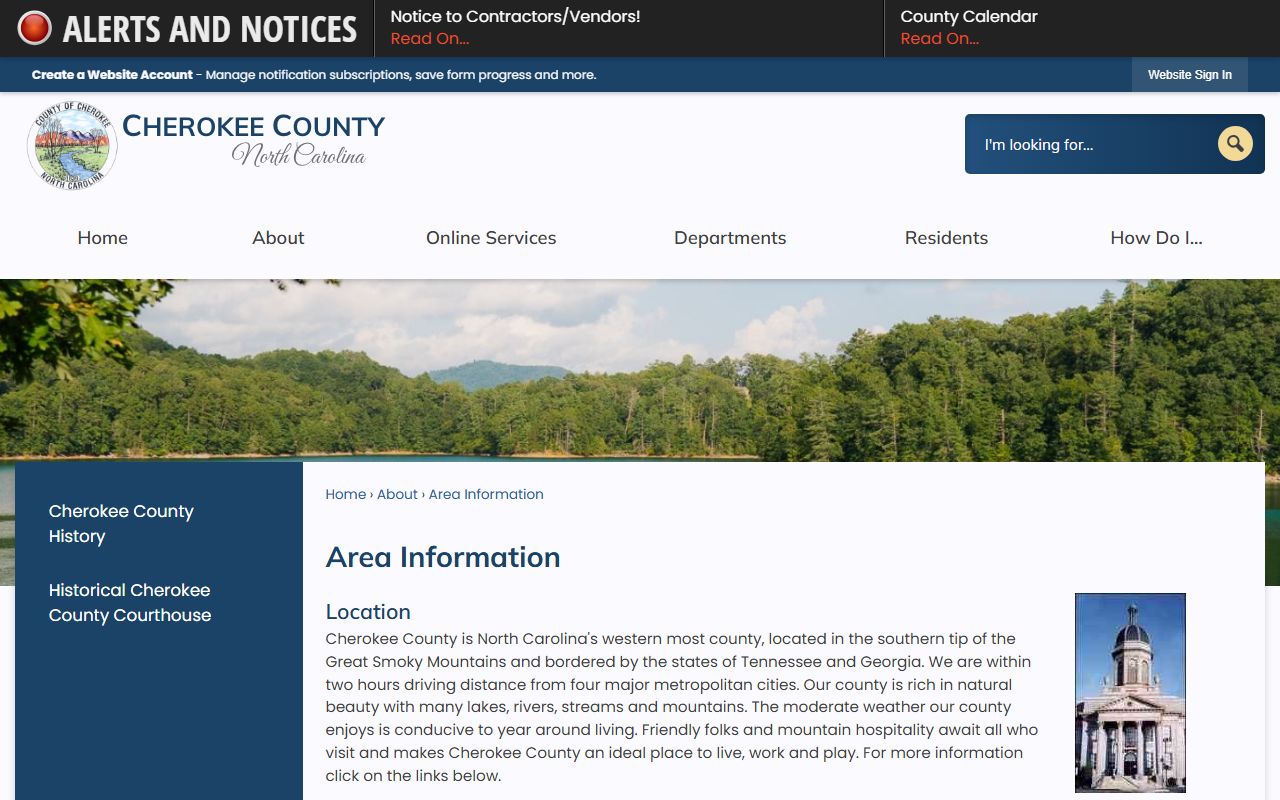
That county context helps explain why the Murphy courthouse, county offices, sheriff records, and Register of Deeds records are often searched together.
Cherokee County Court FAQs
Where do I search Cherokee County Court records online?
Use the North Carolina eCourts Portal for Smart Search, hearing searches, eligible payments, and judgment searches. Set the location to Cherokee County when possible. Use the clerk counter when a certified copy, paper file, divorce judgment, estate file, or official criminal search is needed.
Are Cherokee County warrants online?
No official public Cherokee County Sheriff warrant-search portal was found in the research. Use the Sheriff's Most Wanted page, call the Sheriff's Office or magistrates, search related court cases in eCourts, and contact the Clerk of Superior Court for returned warrants and court records.
Who keeps marriage records in Cherokee County?
The Register of Deeds keeps marriage licenses and marriage certificates. Divorce judgments are court records held by the Clerk of Superior Court in the county where the divorce was granted.
Can the portal be used for background checks?
The Judicial Branch says the portal is not the recommended source for background checks. Certified single-county criminal record searches go through the Clerk of Superior Court using the official form and fee.
What happens if court closes for weather?
The Judicial Branch says closed or cancelled court sessions are usually rescheduled, and notice is generally sent by mail. People may contact the clerk after reopening for local rescheduling information.